
Tolerance cassava to different herbicides applied in post-emergence
DOI:
https://doi.org/10.7824/rbh.v15i3.478Keywords:
chemical control, Manihot esculenta Crantz, intoxication by herbicidesAbstract
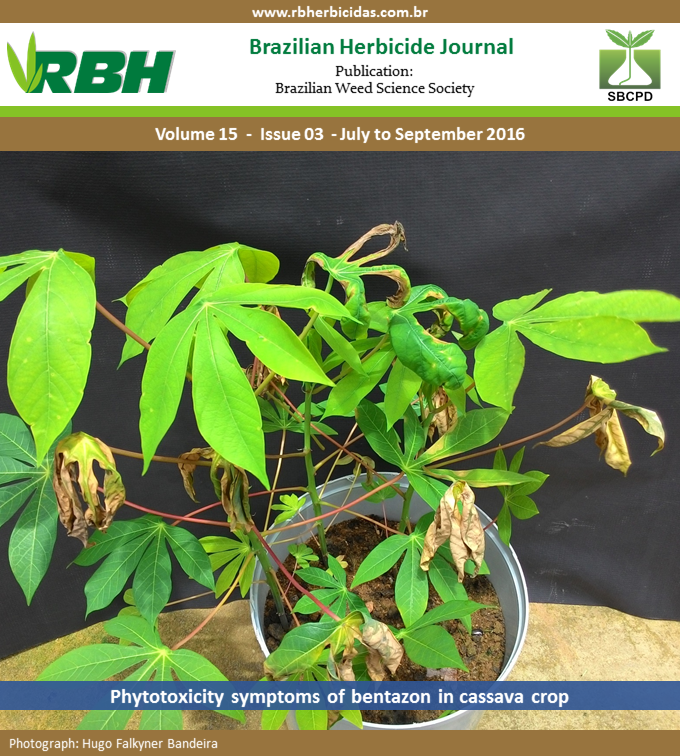
Cassava has a long cycle and slow initial growth, which facilitates development of weeds that will compete with the culture. It was aimed to evaluate the tolerance of cassava cultivar Aciolina, the different herbicides in the early stages of crop development. The experiment was conducted in a greenhouse, in a completely randomized design with four replications. The evaluated treatments were: haloxyfop (60 g ha-1 a.i.), lactofen (180 g ha-1 a.i.), chorimuron-ethyl (17.5 g ha-1 a.i.), bentazon (576 g ha-1 a.i.), bentazon + imazamox (600 + 28 g ha-1 a.i.), imazethapyr (100 g ha-1 a.i.), fomesafen (250 g ha-1 a.i.), quizalofop-P-ethyl (62.5 g ha-1 a.i.), lactofen + quizalofop-P-ethyl (180 + 62.5 g ha-1 a.i.), fomesafen + quizalofop-P-ethyl (250 + 62.5 g ha-1 a.i.), and a control. Were performed visual assessments of intoxication, plant height and number of leaves, dry mass of the leaves, stem, root dry mass total and leaf area. The herbicides bentazon, fomesafen and fomesafen + quizalofop-P-ethyl caused high injury but not affect the development of plants. The imazethapyr herbicide interfered in development of culture by reducing in 58.03% the height and 35.87% dry weight of plants. Deformations were observed in young leaves with treatment bentazon + imazamox. The use of lactofen + quizalofop-P-ethyl resulted in plant death, the use of lactofen significantly reduced all variables. Cassava, cv. Aciolina, showed tolerance to herbicides haloxyfop and quizalofop and chlorimuron-ethyl. The lactofen, imazethapyr, bentazon + imazamox and quizalofop + lactofen cause severe damage to the cassava crop.Downloads
Download data is not yet available.
Downloads
Published
2016-09-10
Issue
Section
Herbicide selectivity to cultivated species


